Top 10 Largest Deserts in the World Ranked by Size (2026)
Published: 17 Mar 2026
Deserts are some of the most extreme and captivating places on Earth. They tell stories of survival, isolation and raw beauty. While most people think of deserts as hot and barren, some are icy and surprisingly vast.
In this guide, we explore the Top 10 largest deserts in the world, ranking them by size and giving you a clear view of where they are. Along the way, you will see a deserts map, learn about the biggest deserts in Africa, and discover surprising facts about deserts you may not have heard of.
Whether you’re a traveler, student or just curious about these natural wonders, this post gives you a complete picture of Earth’s great deserts.
What Is a Desert?
A desert is a dry place that gets very little rain. Technically, a desert is any region that receives very little rainfall usually less than 250 mm (10 inches) per year. But deserts aren’t all scorching sand, some are frozen and wind-swept like Antarctica. Each desert has its own personality.
Life here survives through clever adaptations, from drought-resistant plants to animals that store water or stay cool during the day. Understanding what makes a desert unique helps explain why some of them, like the biggest deserts in Africa or Antarctica, cover massive areas of our planet.
When most people think of deserts, they imagine endless sand and scorching heat but the largest desert on Earth is actually Antarctica, a vast, icy wilderness that stretches farther than any sandy desert.
List of Deserts in the World
The table below shows the list of 10 largest deserts in the world by total area. It includes each desert’s size, type, and location. Cold deserts like Antarctica and the Arctic dominate the ranking, while the Sahara Desert remains the largest hot desert on Earth.
| Rank | Desert | Area (km²) | Type | Location |
|---|---|---|---|---|
| 1 | Antarctic Desert | 14,200,000 | Polar | Antarctica |
| 2 | Arctic Desert | 13,900,000 | Polar | Arctic Region |
| 3 | Sahara Desert | 9,200,000 | Hot | North Africa |
| 4 | Great Australian Desert | 2,700,000 | Hot | Australia |
| 5 | Arabian Desert | 2,330,000 | Hot | Middle East |
| 6 | Gobi Desert | 1,295,000 | Cold Winter | China & Mongolia |
| 7 | Kalahari Desert | 900,000 | Hot | Southern Africa |
| 8 | Patagonian Desert | 673,000 | Cold Winter | Argentina |
| 9 | Syrian Desert | 500,000 | Hot | Middle East |
| 10 | Great Basin Desert | 492,000 | Cold Winter | United States |
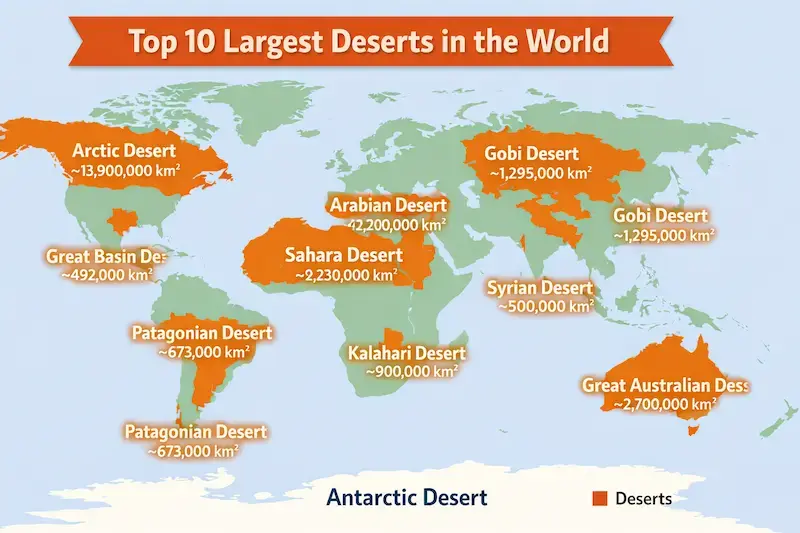
Map of the Largest Deserts in the World
This deserts map shows the largest deserts across continents, from Africa’s vast sands to Antarctica’s icy plains. With a glance, you can see where each desert sits and how massive they really are.
Top 10 Largest Deserts in the World
Here are the top 10 largest deserts in the world, ranked by size. Let’s break down each one and see what makes it special.
1. Antarctic Desert
The largest desert Antarctica is located at the South Pole. It covers the entire continent of Antarctica. Even though it is full of ice, it is still a desert because it gets very little rainfall.
2. Arctic Desert
The Arctic Desert is found around the North Pole. It spreads across parts of countries like Canada, Russia, and Greenland. The land stays frozen most of the year, so very few plants can grow here.
3. Sahara Desert
The Sahara is one of the most famous deserts in the world and the largest hot desert. It is located in North Africa and stretches across many countries. It is also one of the biggest deserts in Africa, known for its huge sand dunes and extreme heat.
4. Great Australian Desert
The Great Australian Desert is located in the center of Australia. It includes several desert regions and covers a large part of the country. The land is dry, with sand and rocky areas, making it one of the largest deserts outside Africa.
5. Arabian Desert
The Arabian Desert is in the Middle East, mainly in Saudi Arabia. It is known for its vast sandy areas and very hot climate. It is one of the most famous deserts of the world due to its size and harsh conditions.
6. Gobi Desert
The Gobi Desert is in Asia, mainly in China and Mongolia. It is different from many deserts because it is mostly rocky, not sandy. It has very cold winters and hot summers.
7. Kalahari Desert
The Kalahari is one of the biggest deserts in Africa, located in southern Africa. It is not completely dry and has some grass and plants. Many animals live here, making it different from typical deserts.
8. Patagonian Desert
The Patagonian Desert is the biggest desert in South America. It is located in Argentina, east of the Andes Mountains. This desert is dry and windy, with large open plains.
9. Syrian Desert
The Syrian Desert is in the Middle East, covering parts of Syria, Jordan, and Iraq. It is mostly rocky and very dry. It has been an important travel route for people for many years.
10. Great Basin Desert
The Great Basin Desert is in the western United States. It is a cold desert with both hot summers and cold winters. It has mountains and valleys, making it different from sandy deserts.
Biggest Deserts by Continent
Biggest Desert in Africa
The largest desert in Africa is the Sahara Desert. It is also the biggest hot desert in the world. It covers a large part of North Africa and is known for its huge sand dunes and very hot climate.
Biggest Desert in Asia
The largest desert in Asia is the Arabian Desert. It is located in the Middle East, mainly in Saudi Arabia. It has vast sandy areas and very little rainfall.
Biggest Desert in Australia
The largest desert in Australia is the Great Australian Desert. It is not just one desert but a group of deserts that cover much of the central part of the country.
Biggest Desert in South America
The biggest desert in South America is the Patagonian Desert. It is located in Argentina and is known for its dry, windy plains.
Largest Desert in North America
The largest desert in North America is the Great Basin Desert. It is a cold desert found in the western United States. It has mountains, valleys, and dry land.
Largest Desert in Antarctica
The largest desert Antarctica is the Antarctic Desert. It covers the entire continent and is the biggest desert in the world. Even though it is covered in ice, it gets very little rain.
Largest Desert in Europe
Europe does not have a true large desert. Some small areas have dry conditions, but there is no major desert like in other continents.
Famous Deserts Around the World
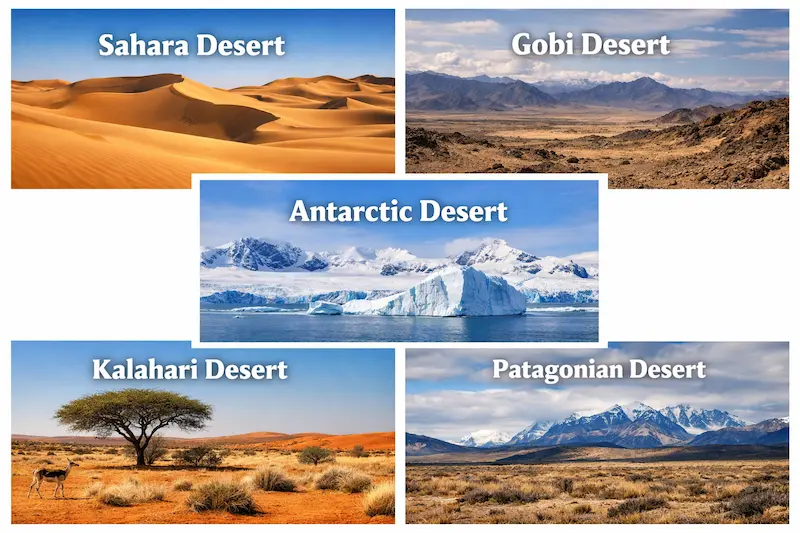
Deserts aren’t just empty sand. Some deserts are famous because they are huge, unique or full of interesting things.
The Sahara Desert is the biggest hot desert in Africa. It has endless sand dunes and camels that people use to travel.
The Gobi Desert in Asia is mostly rocks, not sand, and scientists have even found dinosaur fossils there.
Antarctica is cold and icy, but it’s actually the largest desert in the world because it gets almost no rain.
Other deserts, like the Kalahari, Patagonian and Arabian Desert are smaller but special. They have different plants, animals and landscapes that make them worth learning about.
Each desert is different and visiting or studying them helps us see how amazing and varied deserts can be.
Is Antarctica the Largest Desert in the World?
Yes, Antarctica is the largest desert in the world. This might sound surprising because it is covered in ice, not sand. But a desert is defined by how little rain it gets, not by temperature.
Antarctica receives very little precipitation each year, making it an extremely dry place. That is why it is classified as a desert. In fact, it is much larger than any hot desert, including the Sahara.
So, even though most people think of deserts as hot and sandy, Antarctica proves that deserts can also be cold and icy.
Interesting Facts About the World’s Largest Deserts
Deserts aren’t just empty lands, they’re full of surprises! Here are some cool facts about the world’s biggest deserts:
- Antarctica is the largest desert in the world, but it’s covered in ice instead of sand. It hardly rains there, which is why it counts as a desert.
- The Sahara is the largest hot desert. Its sand dunes can move with the wind and sometimes cover entire villages!
- The Gobi Desert isn’t sandy at all, it’s mostly rocks and gravel. Scientists have found dinosaur fossils there.
- The Kalahari Desert has some plants and animals that you won’t see anywhere else, like the meerkat.
- The Patagonian Desert in South America is very windy and its dry plains make it look almost like a painting.
- Deserts can be hot or cold. Even the icy deserts like Antarctica or the Arctic count because they don’t get much rain.
- Life finds a way. Many deserts have plants and animals that survive with almost no water. Some cacti can store water for years and some desert foxes can survive extreme heat.
If you love learning about Earth’s extreme landscapes, Don’t miss our guides to Top 10 Highest Mountains in the World and the Major Mountain Ranges of the World.
Summary
The world’s deserts are amazing and very diverse. Some, like the Sahara are hot and sandy, while others, like Antarctica, are icy and cold. They cover millions of square kilometers and have unique plants, animals, and landscapes.
Learn more about desert ecosystems and wildlife at National Geographic that helps us to understand how life adapts to extreme conditions and shows just how incredible our planet is. Whether hot, cold, sandy or rocky, deserts are full of surprises waiting to be explored.