Which Is the Longest River in the World? (2026 Ranking + Nile vs Amazon Comparison)
Published: 24 Mar 2026
If you’re wondering which river is the longest in the world, here’s the quick answer:
The longest river in the world is the Nile River, measuring approximately 6,650 km (4,130 miles). It flows through northeastern Africa and has historically been considered the longest, although some studies suggest the Amazon River may be longer depending on how its length is measured.
The longest rivers of the world stretch across continents, shaping landscapes, ecosystems and human history. From the iconic Nile in Africa to the vast Amazon in South America, these rivers are not just defined by length but also by their global importance.
In this guide, you will discover the top 10 longest rivers in the world, ranked by length, along with their countries, key facts and a clear comparison table to help you understand how they truly measure up.
We measured each river from its farthest source to its mouth, verified lengths in km and miles and checked every river’s path through all countries using trusted maps and references. Figures reflect the latest data, including updates where sources differ.
Longest Rivers in the World: Top 10 List with Sources & Countries
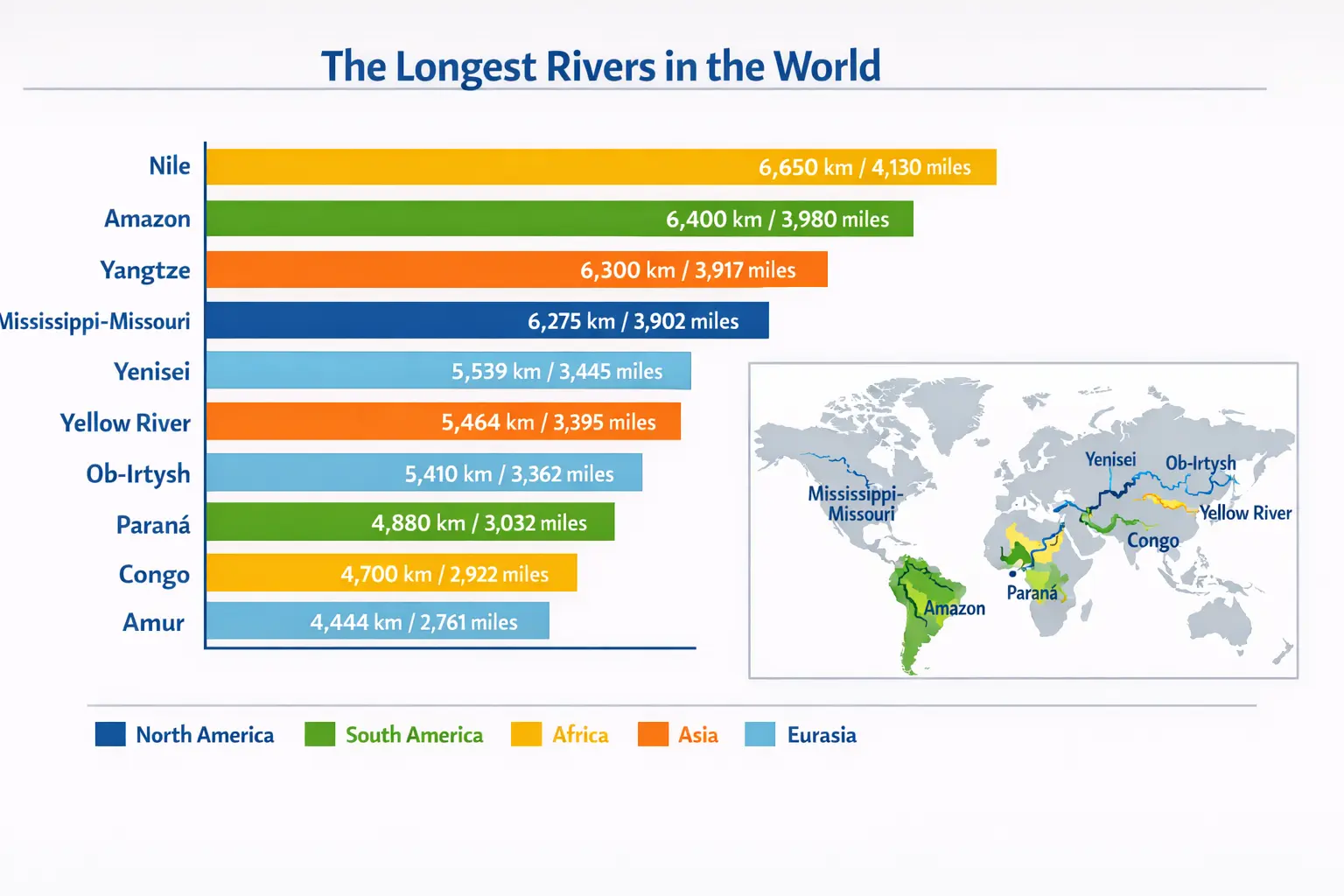
Here’s a quick comparison of the longest rivers in the world, including their length, countries and origin:
| Rank | River | Length (km / mi) | Countries | Source |
|---|---|---|---|---|
| 1 | Nile River | 6,650 km / 4,130 mi | Burundi, Rwanda, Tanzania, Uganda, Kenya, DR Congo, Ethiopia, Eritrea, South Sudan, Sudan, Egypt | Rukarara River (Rwanda) / Lake Victoria |
| 2 | Amazon River | 6,400 km / 3,976 mi | Peru, Colombia, Brazil | Andes Mountains (Peru) |
| 3 | Yangtze River | 6,300 km / 3,917 mi | China | Jari Hill, Tanggula Mountains (Tibetan Plateau) |
| 4 | Mississippi–Missouri River System | 6,275 km / 3,902 mi | United States | Brower’s Spring (Montana) / Lake Itasca (Mississippi) |
| 5 | Yenisei–Angara–Selenga River | 5,539 km / 3,445 mi | Mongolia, Russia | Selenga River (Mongolia) |
| 6 | Yellow River (Huang He) | 5,464 km / 3,395 mi | China | Bayan Har Mountains (Qinghai) |
| 7 | Ob–Irtysh River System | 5,410 km / 3,364 mi | Russia, Kazakhstan, China, Mongolia | Confluence of Biya & Katun / Altai Mountains |
| 8 | Paraná & Río de la Plata | 4,880 km / 3,030 mi | Brazil, Argentina, Paraguay, Bolivia, Uruguay | Confluence of Paranaíba & Grande Rivers |
| 9 | Congo River | 4,700 km / 2,922 mi | DR Congo, Republic of the Congo, Central African Republic, Angola, Cameroon, Zambia, Tanzania, Burundi, Rwanda | Chambeshi River / Lualaba (upper headwaters) |
| 10 | Amur River | 4,444 km / 2,761 mi | Russia, China, Mongolia | Confluence of Shilka & Argun Rivers |
Note: River lengths are approximate and include primary tributaries. Data compiled from reliable geographic and scientific sources.
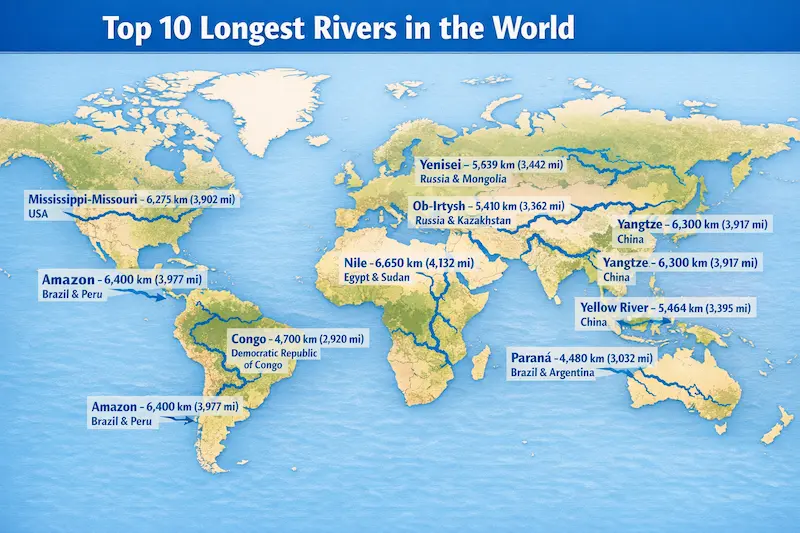
Top 10 Longest Rivers in the World – Map & Details
This map shows the world’s ten longest rivers, labeled with their names, lengths and the countries they flow through for a clear global overview.
Nile vs Amazon – Which Is Actually Longer?
The Nile River is traditionally considered the longest at around 6,650 km (4,130 miles). However, some studies suggest the Amazon River may be longer depending on which tributaries are measured as the source. Both rivers are globally significant and support millions of people, but the debate continues among geographers.
Just like the Nile and Amazon dominate rivers, our post on the world’s largest deserts shows which landscapes hold the record for size.
Top 10 Longest Rivers in the World Ranked by Length
Every river has a source and a mouth, the source is where it begins and the mouth is where it flows into a sea, ocean or lake.
Here’s a closer look at the top 10 longest rivers in the world, ranked from longest to shortest.
1. Nile River
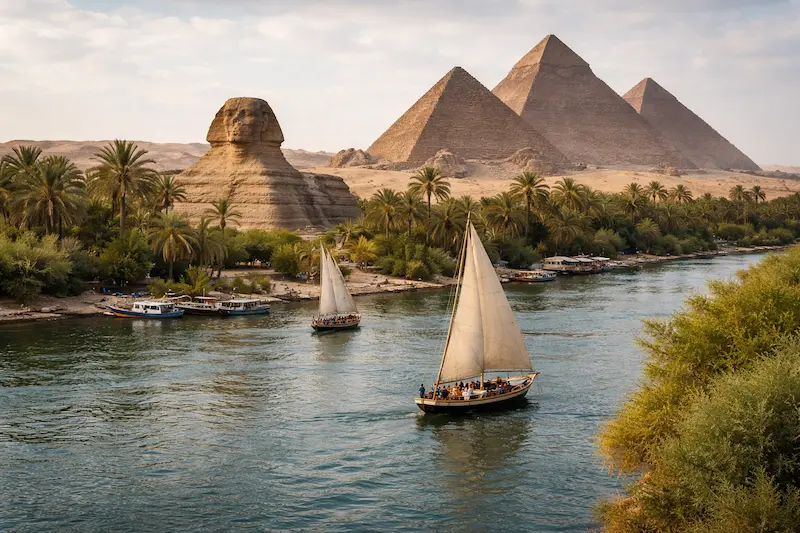
Length: 6,650 km (4,130 miles)
Countries: Egypt, Sudan, South Sudan, Ethiopia, Uganda
Source: Lake Victoria region
Mouth: Mediterranean Sea
Why it matters:
The Nile is considered as the longest river in the world. It supported ancient Egyptian civilization and still provides water and agriculture for millions.
Interesting fact:
It flows northward, which is unusual for major rivers.
2. Amazon River
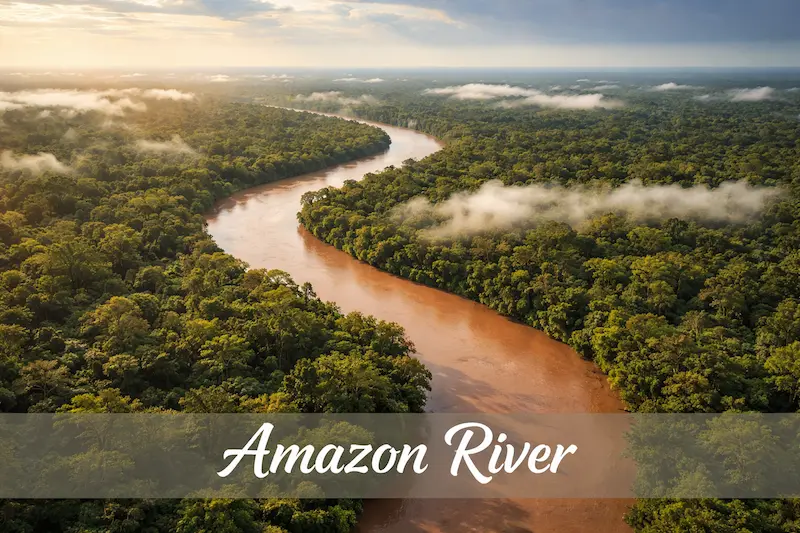
Length: ~6,400 km (3,976 miles)
Countries: Brazil, Peru, Colombia
Source: Andes Mountains (Peru)
Mouth: Atlantic Ocean
Why it matters:
The Amazon holds the largest water volume of any river and plays a key role in regulating the global climate.
Interesting fact:
Some studies suggest the Amazon may actually be longer than the Nile, depending on how its source is measured.
3. Yangtze River
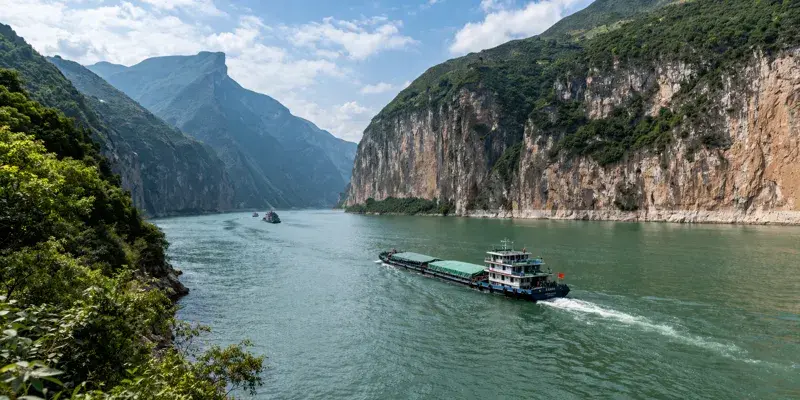
Length: 6,300 km (3,915 miles)
Countries: China
Source: Tibetan Plateau
Mouth: East China Sea
Why it matters:
The Yangtze is the longest river in Asia and supports one of the most populated regions on Earth.
Interesting fact:
It is home to the world-famous Three Gorges Dam.
4. Mississippi–Missouri River System
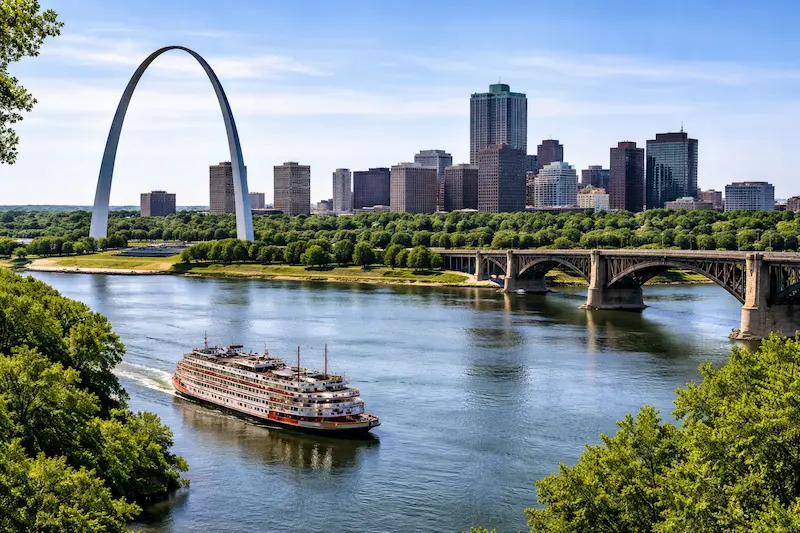
Mississippi River at St. Louis, part of the Mississippi–Missouri River System
Length: 6,275 km (3,902 miles)
Countries: United States
Source: Lake Itasca (Mississippi)
Mouth: Gulf of Mexico
Why it matters:
This river system is essential for transport, agriculture, and trade in North America.
Interesting fact:
It forms one of the largest drainage systems in the world.
5. Yenisei River
Length: 5,539 km (3,445 miles)
Countries: Russia, Mongolia
Source: Mongolia highlands
Mouth: Arctic Ocean
Why it matters:
One of the largest rivers flowing into the Arctic, cutting through vast Siberian regions.
Interesting fact:
It passes through some of the most remote landscapes on Earth.
6. Yellow River (Huang He)
Length: 5,464 km (3,395 miles)
Countries: China
Source: Bayan Har Mountains
Mouth: Bohai Sea
Why it matters:
Known as the cradle of Chinese civilization, it played a key role in early human settlements.
Interesting fact:
Its yellow color comes from heavy sediment flow.
7. Ob–Irtysh River System
Length: 5,410 km (3,364 miles)
Countries: Russia, Kazakhstan, China
Source: Altai Mountains
Mouth: Arctic Ocean
Why it matters:
A major river system in western Siberia with strong economic importance.
Interesting fact:
It remains frozen for a large part of the year.
8. Paraná River
Length: 4,880 km (3,032 miles)
Countries: Brazil, Paraguay, Argentina
Source: Brazilian Highlands
Mouth: Río de la Plata
Why it matters:
A crucial river for hydroelectric power and regional trade in South America.
Interesting fact:
It feeds the massive Itaipu Dam, one of the largest in the world.
9. Congo River
Length: 4,700 km (2,922 miles)
Countries: DR Congo, Republic of Congo
Source: East African highlands
Mouth: Atlantic Ocean
Why it matters:
The Congo is the deepest river in the world and a lifeline for Central Africa.
Interesting fact:
It is one of the few rivers that crosses the equator twice.
10. Amur River
Length: 4,444 km (2,760 miles)
Countries: Russia, China
Source: Argun and Shilka rivers
Mouth: Sea of Okhotsk
Why it matters:
It forms a natural border between Russia and China and supports diverse ecosystems.
Interesting fact:
It is home to rare species like the Amur tiger.
If you love exploring extremes, check out our guide to the Highest Mountains in the World and see how rivers often begin in these towering peaks.
Longest Rivers by Continent (Africa, Asia, Europe & More)
Every continent has a river that stands out for its length and importance. In Africa, the Nile stretches over 6,600 km and helped build ancient civilizations. South America’s Amazon carries the most water in the world and is full of amazing wildlife.
Asia has the Yangtze and the Yellow River, both supporting millions of people. North America’s Mississippi–Missouri system is huge for trade and farming while the longest rivers in Europe include the Volga, the Danube and the Dnieper.
Beyond these major waterways, rivers such as Luni River in India are notable for their unique geographical characteristics and regional significance.
Even smaller continents have notable rivers like Australia’s Murray and Antarctica’s Onyx which flows only during summer melt. For more details about rivers around the world, see this Educational Guide on Rivers from Britannica.
For more record-breaking world wonders, you can explore our posts on the Largest Aquariums and Biggest Zoos in the World.
Fun Facts You Didn’t Know About the World’s Longest Rivers
- The Nile flows north – Unlike most rivers, it moves from the highlands of East Africa toward the Mediterranean.
- Amazon’s hidden length – Depending on which tributary you consider its true source, the Amazon might actually be slightly longer than the Nile.
- Yangtze’s enormous dam – The Three Gorges Dam is so massive that it has permanently changed local ecosystems and displaced over a million people.
- Mississippi–Missouri’s giant drainage – This river system covers nearly half of the United States, connecting hundreds of smaller rivers and streams.
- Yellow River’s golden color – Sediment from the Loess Plateau turns the river yellow, shaping farmland and sometimes causing massive floods.
- Congo’s underwater depths – Parts of the river drop more than 220 meters, making it the deepest river in the world.
- Paraná powers nations – The Itaipu Dam on the Paraná River produces electricity for both Brazil and Paraguay, powering millions of homes.
- Onyx River’s seasonal flow – Antarctica’s longest river only appears during the short summer months and vanishes in winter.
- Rivers and rainfall – Some rivers, like the Amazon, are so wide that they create their own local rainfall patterns along the basin.
- Nile’s historical importance – Even today, it remains the main water source for millions in Egypt and Sudan.
- Volga’s freezing winters – Europe’s longest river can freeze over completely in winter, halting shipping for months.
- Yangtze’s biodiversity – The river supports hundreds of unique species, some found nowhere else on Earth.